Sunday, June 26, 2011

Nokia's new flagship N9 gets mixed reviews

Nokia's latest attempt to win back market share with its N9 phone received mixed reviews on Wednesday but analysts said the real test will come when it releases new models using the Windows Phone 7 operating system.

Fans lauded the N9's ease of use without any "home" button -- a feature of the iPhone and other rivals -- while detractors mocked what they saw as its outdated Meego operating system.

Unveiled by Nokia chief executive Stephen Elop at the CommunicAsia telecoms fair in Singapore this week, fans crowded around the company's booth to try out the device.

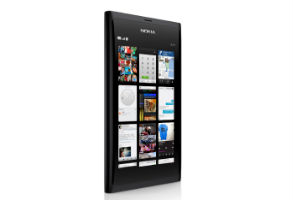
The N9 has a 99-millimetre (less than four inches), 854 x 480 pixel display and weighs 135 grams (less than five ounces), putting it clearly in iPhone territory.

Its most distinctive feature is an "all-screen" display, with users swiping the screen to switch between applications.

The device also has a function that allows users to link it to dedicated accessories such as a headset or speakers by simply touching the phone against them.

"Being a user of Apple, an iPhone, this is light years ahead of what iPhone 3G does," declared Paul Krzystoszek, operations and marketing manager for Australian Satellite Communications.
"The ease of use... the intuitive nature of swiping across the screen instead of using a button, there's no button on it, the plastic casing, I think they're all things that make it a lot better than what we have already," he told AFP after trying the phone at the Nokia booth.

"Awesome" was how Shahiran Jaafar, chief executive officer of Malaysian firm Microtel Systems and user of an iPhone 3G, described the N9.

"The fact that you can just swipe it and it goes back to whatever screen that you need it to go back to, the fact that it can show all the open tasks that's available, that's fantastic," he said.

"It just dwarfs the iPhone, the iPhone is nothing now."

However, some were unimpressed by the fact that the N9 was still operating on Nokia's MeeGo platform despite the company's impending adoption of the Windows Phone 7 platform later this year.

"I have a problem with... the operating system," said Phoosith Ratpiyasoontorn, a Thai systems integration engineer, lamenting that MeeGo lacked user volume and compatibility with many applications.

Technological consultancy firm Ovum's consumer information technology analyst Tim Renowden said the true test of whether Nokia can reverse its sagging fortunes will be when its new handsets using Windows Phone 7 are rolled out.

"The N9 is an interesting demonstration that Nokia can still build excellent hardware, and it shows the progress made on the MeeGo OS," he said.

"But it doesn't change the fact that most Nokia fans will be waiting for the first Windows Phone 7 handsets to arrive later this year," he told AFP.

"With Nokia's focus shifting to Windows Phone 7 it's hard to get excited about MeeGo on Nokia hardware, despite the apparent merits of the N9 itself."

Ratpiyasoontorn added that the choice for him would be clear if the N9 was stacked up against the iPhone.

"iPhone for sure because the ecosystem, they have a lot more content, more applications," he said.

In Finland, Nokia touted the virtues of Meego as the N9 was unveiled in Asia.

"It reflects a change in philosophy, hardware and software coming together at Nokia in a very specific way to create a device," said Peter Skillman, Nokia Vice President of Services and Meego Design.

"This impacts everything from smartphones to low-end phones right across the board."

Android phones to pit vampires against slayers

Facial recognition startup Viewdle on Wednesday began letting Android smartphone users see which of the people around them are vampires and which are vampire slayers.
A "Third Eye" augmented reality game released by the San Francisco company online at viewdle.com is the first installment in a trilogy that will culminate in a battle between the undead and defenders of the living.

It was also intended as a fun demonstration of a powerful software platform that lets smartphone cameras recognize what they see and potentially support services such as sight for the blind or memories for the forgetful.

"It is true science fiction on some level," Viewdle chief product officer Jason Mitura told AFP. "The way people use their devices to interact with the world is going to change dramatically."

At the heart of the vampire-themed game is Viewdle's facial recognition technology that debuted in April in the form of a SocialCamera application for Android-powered smartphones.
SocialCamera uses computer algorithms to create "faceprints" that people can tag with names and store in smartphones. The software then matches faceprints to subjects in subsequent photos.

Android smartphones can instantly connect names to those in photos and share the images using social networking service Facebook, photo-sharing website Flickr, or by email or instant message.

"Third Eye" uses facial characteristics to evaluate whether people viewed through smartphone cameras are "blood suckers" or humans who can be recruited as vampire slayers.

The objective of the first part of the game is to amass an army and establish alliances for battles between clans that will play out in installments due for release later this year.

"The gaming mechanism forces play that requires people to interact with the real world," Mitura said. "You hold the smartphone up to an object and it triggers game play; in this case the object is a person."

Viewdle has avoided controversy by putting the facial recognition power in smartphones with users keeping control, instead of putting the information on servers in the Internet "cloud."

Viewdle is working with chip and smartphone makers that are building computer vision into their offerings.

Viewdle bills itself as the leading independent facial recognition company for consumer gadgets. Its technology is developed by the company's research team in the Ukraine.

Viewdle is the result of 15 years of research, rooted in work done at The Cybernetics Institute in Kiev, and got its first infusion of investor money -- 2.5 million dollars -- in June 2008.

High-powered players in September pumped $10 million into the Palo Alto, California, startup devoted to crafting ways to let smartphones "see" things the same way people do.

The influx of cash came from Qualcomm, BlackBerry Partners Fund, US electronics retail chain Best Buy, and Anthem Venture Partners, an investment firm that has backed Viewdle from the outset.

"We are giving smartphones human eyes," Viewdle co-founder and chief executive Laurent Gil told AFP.

"Letting them see the world the way people do... it is artificial intelligence," he said. "It is happening."

Viewdle plans to make a software developers kit available to gadget makers interested in building computer vision into devices.

"It is an exciting future for computer vision," Mitura said.

US tablet users paid $53 for apps: study

More than 90 percent of US tablet computer users have downloaded applications and most have bought apps, spending over $50 on average during the past 12 months, according to a study released on Wednesday.

Twelve percent of the total US population own or use a tablet, the study by the Online Publishers Association (OPA) found, with the number expected to rise to 23 percent, or 54 million people, by early 2012.

Ninety-three percent of tablet users have downloaded apps, the study said, with the average tablet user downloading 20 apps, predominantly for weather, games and music, social networking and news.

Seventy-nine percent of those who have downloaded apps have paid for apps during the past 12 months, spending $53 on apps during the period, the OPA study said.

Twenty-six percent of all apps downloaded are paid apps with games making up more than 50 percent of the apps people paid for, it said.

The study also found that 60 percent of tablet users are men and 48 percent are between the ages of 18 and 34.

Tablet owners were largely happy with their devices, the study found. Eighty-nine percent said they were satisfied or very satisfied with their tablet.

Apple's iPad was the tablet of choice among those surveyed with 46 percent saying they owned or used an iPad and 21 percent saying they owned or used an iPad 2.

The next most popular tablets were the Android-powered Samsung Galaxy, the Dell Streak and the HP Slate.

The survey of 2,482 people between the ages of eight and 64 was conducted by Frank Magid Associates between April 15 and April 20 and has a margin of error of plus or minus 1.97 percentage points.

Sony Ericsson eyes Android market with new phones

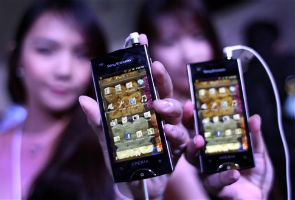
Mobile phone maker Sony Ericsson unveiled two new Android models on Wednesday in a bid to grab more of the burgeoning smartphone market.

The company, a joint venture between L.M. Ericsson and Sony Corp., plans to launch the Xperia ray and Xperia active models during the third quarter, Chief Marketing Officer Steve Walker announced in Singapore.

The new models should help the company expand its 11 percent market share of the Android segment, Walker said.

"Android smartphones is a rapidly growing part of the market, and we see our share within that market growing," Walker told The Associated Press.

London-based Sony Ericsson, which saw its phone unit sales drop 23 percent in the first quarter from a year earlier, is moving away from cheaper phone models and seeking to take on Apple Inc.'s iPhone, Research in Motion's Blackberry and Nokia Corp.'s N9 in the higher-priced smartphone market.

By 2015, about 60 percent of mobile phones sold in the Asia-Pacific region will likely be smartphones, up from 20 percent in 2010, Walker said.

"We made quite a fundamental shift in strategy and decided to focus a large part of our efforts into smartphones, to focus on the mid- and high-end part of the business," Walker said. "In many markets, we see a dramatic shift from feature phones to smartphones."

The company said in April that smartphones accounted for more than 60 percent of its sales during the first quarter.

Sony Ericsson's latest models that run on Goggle Inc.'s Android platform, the Xperia ray and active, will likely be priced below the high-end Xperia arc, Walker said.

Xperia active is water resistant and works if fingers are wet or sweaty, while the Xperia ray seeks to combine a sleek design with a device that is 9.4 millimeters thick (about 1/3 inch-thick).

Sony Ericsson also plans to introduce a less expensive model that highlights texting service and is aimed at teenagers, Walker said.

Apple removes anti-Israel app from App Store

Apple Inc. says it has removed an application called "ThirdIntifada" from its App Store following complaints that it glorified violence against Israel.

Israel's information minister, Yuli Edelstein, requested the company remove the app in an email he sent to Apple CEO Steve Jobs. Jewish human rights group The Simon Wiesenthal Center also complained to Apple.

"Intifada" is the Arabic term for two violent uprisings against Israel over the past two decades. The free application encouraged followers to share opinions and organize protests against Israel.

It linked to a website that helped organize violent clashes with Israeli troops recently along Israel's frontiers with Lebanon and Syria.

Apple spokesman Tom Neumayr said on Wednesday that the app was removed "because it violates the developer guidelines by being offensive to large groups of people."

BlackBerry maker launches PlayBook in India

It's here - the PlayBook from BlackBerry maker RIM has launched in India two months after it was released in the USA on April 19.

The much anticipated PlayBook - a strong contender for the iPad's alpha tablet title - has received mixed reviews across the world. While it is intuitive to use with innovative swipe gestures, it lacks a good app ecosystem and does not support email without connecting to a BlackBerry smartphone. However, RIM has announced that updates will be available by the end of this year which will bring in support for email and Android applications.

The QNX powered tablet has a multi-touch enabled 7-inch screen with a resolution of 1024x600. It features a 1GHz Cortex A9 dual-core processor that enables the tablet to support full HD video. The device also features a front and rear facing camera and a micro USB and HDMI out. And there's the Facebook app - the Playbook is the only tablet to have this.

Another important feature of the device is the BlackBerry Bridge. It can seamlessly sync any BlackBerry smartphone to the tablet and gain access to all contacts, messages, mail and more.

The PlayBook also comes pre-loaded with some India specific apps which include Bridal, Commix On The Go, TV On The Go, Bollywood Hungama and Cooking With Tarla Dalal.
The PlayBook will be available in 16 GB, 32 GB and 64 GB versions. It will be priced at Rs. 27,990, Rs. 32,990 and Rs. 37,990 respectively.
 BlackBerry's Playbook is the second major contender to the iPad 2 to launch in India after the Acer A500, which is an Android Honeycomb based tablet. Future competition will launch in the shapes of the Motorola Xoom and the HTC Flyer.

iPhone 4 camera most popular on Flickr

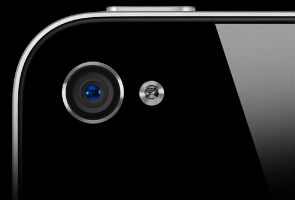
The iPhone 4 has topped charts of a different sort again - it is the most popular camera on the photo sharing website Flickr. Even though the device has a 5MP camera and is quite underwhelming when compared to other smartphones in the industry, it has surpassed the likes of the Nikon D90, Canon EOS 5D Mark II, Canon EOS Digital Rebel XSi and the Canon EOS Rebel T1i.

Not only has the iPhone 4 left professional DSLRs behind, 4 out of the top 5 mobile devices used to upload photos are iOS devices. In order of ranking, these are the iPhone 4, iPhone 3G, iPhone 3GS, HTC Evo 4G and the iPod touch.

Flickr states "camera phones are undercounted." The photo sharing service can identify the camera used to take the photo, and are accurate 2 out of 3 times. Flickr claims to receive more than 4,800 images shot with the iPhone 4 per day, more than any other device.

However, the all time favourite camera device is the iPhone 3GS - over 35 million photos have been uploaded using this. That's the number the iPhone 4 has to beat to take the overall number one spot. Once again, Apple is it's own competition.

The original iPhone with its underwhelming 2MP camera too topped Flickr charts way back in 2008.