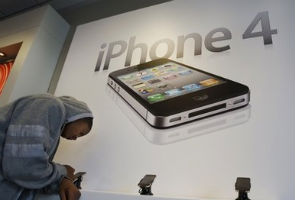
Apple should have responded much sooner to concerns about location data stored on its iPhones, even if the company didn't have all the answers ready, marketing and crisis-management experts say.
The company took a week to deny that the phones track the precise location of their owners, as some users and privacy watchdogs had feared.
As soon as it started selling the devices, Apple should have said how it uses, or doesn't use, location data, said Joe Marconi, a DePaul University marketing professor and author of "Crisis Marketing: When Bad Things Happen to Good Companies."
"The whole problem could have been a non-problem if Apple had done some kind of disclosure of this in some kind of a privacy statement," he said. "Apple customers are fiercely loyal in a way we can say few (others) are today. With that comes a responsibility."
In a list of 10 questions and answers published Wednesday, the company explained that a data file publicized last week by security researchers doesn't store iPhone users' physical locations -- just a list of Wi-Fi hotspots and cell towers surrounding them.
Apple said the data help phones figure out their location without having to listen for faint signals from GPS satellites.
The company did acknowledge that the data are stored for up to a year because of a software bug. It promised a fix in the coming weeks to reduce the duration of the storage.
Larry L. Smith, president of the Institute for Crisis Management, a public relations company, said Apple should have said something sooner in some form, even if it didn't have all the details right away.
"To me there is no excuse to stonewall, to put off facing your customers, your partners, your shareholders, your employees," he said. "When there is a problem, or an issue has been raised, it's so counterproductive to put off responding."
Even a response of "I don't know; I will get back to you" is better than none, he said. "You are not always going to have immediate answers."
Apple spokeswoman Natalie Kerris would not comment on why the company waited to respond.
Speaking to The New York Times, CEO Steve Jobs defended the timing of Apple's response, saying that the company wanted to determine exactly what happened rather than rush to its public relations department.
"The first thing we always do when a problem is brought to us is we try to isolate it and find out if it is real," he said. "It took us about a week to do an investigation and write a response, which is fairly quick for something this technically complicated."
Jobs, who went on medical leave in January, said he was personally involved in writing Wednesday's response, as were other top executives, "because we think it is that important."
Despite all the hoopla, Smith said he doesn't expect Apple's latest blunder to hurt the company in the long run.
Apple quickly recovered from "antennagate," a problem with the iPhone 4's antenna design. It caused reception issues when people covered a certain spot with a bare hand.
Jobs apologized last July to people who were not completely satisfied with the iPhone 4, but denied there was an antenna problem that needed fixing. Even so, the company gave out free protective cases. "Antennagate" didn't seem to make a dent in the iPhone's popularity or sour Apple's devoted fan base.
And, Smith said, the "flap over data won't do the harm today that it might have done a few years ago when our attention span was a little longer. Somebody else will do something stupid tomorrow."
Companies that handle public relations crises well are not remembered long -- that's the whole point. But Apple might learn from fast food companies such as Domino's Pizza and Taco Bell.
When video of a Domino's employee appearing to do disgusting things to food appeared on YouTube, Domino's responded by firing that person and the co-worker who recorded him. Later, CEO Patrick Doyle posted a video in response, saying the store had been sanitized "top to bottom" and that the company is re-examining how it hires workers "to make sure that people like this don't make it into our stores."
Taco Bell, meanwhile, spent millions of dollars on ads to counter a lawsuit that questioned whether the filling in its tacos was actually beef. The lawsuit has been dropped.
Smith said Taco Bell realized their taco customers were mostly men who bought it for the taste and price, not for its nutritional value.
Similarly, Apple might find that many users don't mind their location being tracked because this allows them to get directions, find nearby restaurants and use a slew of other apps and features of the iPhone. In Wednesday's statement, Apple said the data file in question helps speed location-based services.

Motorola Mobility Holdings Inc., the maker of cellphones and cable set-top boxes that split off from the rest of Motorola in January, said Thursday that it narrowed its loss in the first quarter as it nearly doubled shipments of smartphones.
Motorola Mobility posted a loss of $81 million, or 27 cents per share, for the January to March period. That compares with a loss of $212 million, or 72 cents per share, a year ago.
Excluding stock-based compensation and amortization of intangibles, the loss was 8 cents per share, less than the 11 cents per share loss analysts surveyed by FactSet had expected, on average.
Revenue was $3.03 billion, up 22 percent from a year ago, and beat analyst estimates at $2.84 billion.
The Libertyville, Ill.-based company said mobile devices revenue totaled $2.1 billion, up 30 percent from the year-ago quarter.
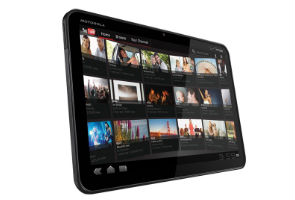
Motorola Mobility shipped 9.3 million of these products during the period, including 4.1 million smartphones and over 250,000 of its recently released Xoom tablet computer. Last year, the company shipped 8.5 million mobile devices -- 2.3 million of them smartphones -- in the first quarter.
"I think we're making good progress on transitioning Motorola into a smartphone and a mobile computing company," CEO Sanjay Jha said in an interview.
The company would not give specifics about how many of the Xooms shipped were actually sold, but Chief Financial Officer Marc Rothman said he was "pleased" with sales of the tablet. The Xoom, which runs on the tablet-geared version of Google Inc.'s Android operating software, was released in late February.
Revenue from Motorola Mobility's home unit, which makes various consumer electronics, climbed 8 percent to $904 million. Growth was helped by demand for cable set-top boxes.
For the current quarter, Motorola Mobility expects to break even or earn as much as 12 cents per share, excluding one-time items. Analysts are hoping for an adjusted profit of 12 cents per share.
The company said it expects smartphone and tablet sales to rise compared with the first quarter, and believes revenue will also climb.
While some tech companies are suffering from supply-issues in the wake of the Japan earthquake in March, Jha said that much of Motorola Mobility's supply chain was unaffected. The company expects no significant impact from the disaster in the current quarter, he said.
Motorola Mobility shares rose 78 cents, or 3.3 percent, to $24.77 in extended trading. The stock had finished regular trading up 37 cents at $23.99.
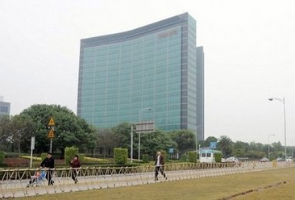
 China telecoms giant Huawei said Thursday it is suing hometown rival ZTE in Europe for alleged patent and trademark infringements, as the Chinese firms battle for overseas market share.
The lawsuits filed in Germany, France and Hungary accuse ZTE, a telecom equipment supplier, of breaching a series of Huawei's patents and illegally using a Huawei-registered trademark on some products.
"Huawei was compelled to initiate this action in order to protect our innovations and registered intellectual property in Europe," said Huawei chief legal officer Song Liuping in a statement.
"Intellectual property is among Huawei's most valuable assets. That is why we feel a responsibility to our customers and to our shareholders to do everything possible to protect these assets in any legal jurisdiction."
ZTE did not immediately respond to AFP requests for comment. Huawei said it took legal action after ZTE failed to respond to "cease and desist letters".
Both Huawei and ZTE are based in the southern boom town of Shenzhen, next to Hong Kong, and are competing in the global telecommunications market.
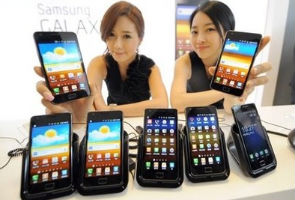
 South Korea's Samsung Electronics on Thursday showcased an updated version of its Galaxy S smartphone designed to compete against rivals such as Apple amid a legal battle with the US giant.
The world's second-largest mobile phone maker aims to sell at least 10 million Galaxy S2 smartphones after its international debut in early May, said Shin Jong-Kyun, president of the mobile business unit.
"We expect the sales to be as good as Galaxy S," Shin told reporters. The original model has sold 14 million units worldwide since July 2010.
The new phone is slimmer, faster and consumes less energy, Shin said.
It will be sold by more than 140 vendors in some 120 countries from early May, and by all three wireless network operators in South Korea from Thursday.
Despite the updated features, Samsung has cut the price of the S2 in South Korea in apparent recognition of the intensifying competition.
It will cost a maximum 847,000 won ($786) through domestic mobile operators, about 100,000 won less than the Galaxy S.
Shin said the firm would also unveil the new version of its Galaxy Tab tablet computer in July, predicting its overall tablet computer sales would be five times bigger this year than in 2010.
The Suwon-based firm is embroiled in a legal battle with Apple, which in a US lawsuit has accused Samsung of "slavishly" copying the design and technologies of its market-leading iPhone and iPad.
Samsung denied the accusation and days later filed lawsuits against Apple in South Korea, Japan and Germany alleging 10 patent infringements.
Shin vowed to "respond resolutely" to Apple's charges and said the company would "deal with the matter more actively".
"Apple not only is our competitor in mobile phone sales but also our client in device component sales," he said.
"We will respond resolutely not only to safeguard our pride and status... but also to protect our customers and business partners."
Apple was Samsung's second-largest client in 2010 after Japan's Sony Corp., accounting for four percent of the South Korean firm's 155 trillion won ($142 billion) annual revenue.
SK Telecom and KT, respectively the number one and two wireless operators in South Korea, said Thursday they will start selling Apple's iPad2 on Friday.
 Canada's Research In Motion (RIM) lowered its earnings outlook on Thursday on weaker BlackBerry sales, sending its share price sharply lower in after-hours trading.
The Waterloo, Ontario-based RIM said that it expects earnings per share of $1.30-$1.37 in the quarter ending May 28, lower than the $1.47-$1.55 forecast just a month ago.
"This shortfall is primarily due to shipment volumes of BlackBerry smartphones that are now expected to be at the lower end of the range of 13.5-14.5 million forecasted in March and a shift in the expected mix of devices shipped towards handsets with lower average selling prices," RIM said.
RIM said it expected revenue for the quarter slightly below the $5.2 billion to $5.6 billion forecast on March 24.
RIM shares were down 8.46 percent at $51.50 in after-hours trading.
RIM also said it expected shipments of its new iPad rival, the BlackBerry PlayBook, to be "in line with our previous expectations" but did not provide any figures.
The Blackberry maker said it has not experienced any significant supply disruptions due to the earthquake and tsunami in Japan.
 Zynga on Wednesday announced that it has bought the British studio that created the popular iPhone, iPad, and iPod game "GodFinger."
The acquisition of Wonderland Software gives the San Francisco social game titan its first base of operations in Britain.
"Wonderland is composed of an amazingly talented, creative team, known for developing deeply engaging and innovative games," said Zynga senior vice president of mobile David Ko.
"I'm incredibly excited to have Wonderland join Zynga as we build a presence in the United Kingdom."
Zynga bought the Wonderland team and some of the two-year-old studio's intellectual property, but the deal did not include the rights to "GodFinger." The purchase price was not disclosed.
Wonderland chief executive Matthew Wiggins was appointed general manager of the studio, which was renamed Zynga Mobile UK, and reports to Ko.
"Wonderland Software has always been dedicated to pursuing big and creative ideas and turning them into games that players love," Wiggins said.
"We are thrilled to continue our vision as part of the Zynga family and to reach millions of mobile players across a spectrum of devices."
Zynga was founded in July 2007 by Mark Pincus, who named the startup after his late bulldog "Zinga."
Zynga boasts more than 250 million players, most of them at online social network Facebook. Its titles include FarmVille, Mafia Wars, CityVille, Caf� World, Zynga Poker, and Vampire Wars.
Apple says the long-delayed white iPhone 4 will go on sale Thursday in the United States, United Kingdom and 26 other countries for $199 or $299 depending on the model.
Apple Inc. said Wednesday the prices are for phones purchased with a two-year contract from AT&T Inc. or Verizon Wireless in the U.S.
The black iPhone 4 went on sale last June. Apple had hoped to make the white phones available in July, then in late 2010. But it has said that the gadget was more challenging to produce than expected. In October, Apple said the white phones would be available in the spring.
Separately, Apple says the iPad 2 will go on sale in Japan on Thursday and in Hong Kong, South Korea, Singapore and eight more countries on Friday.